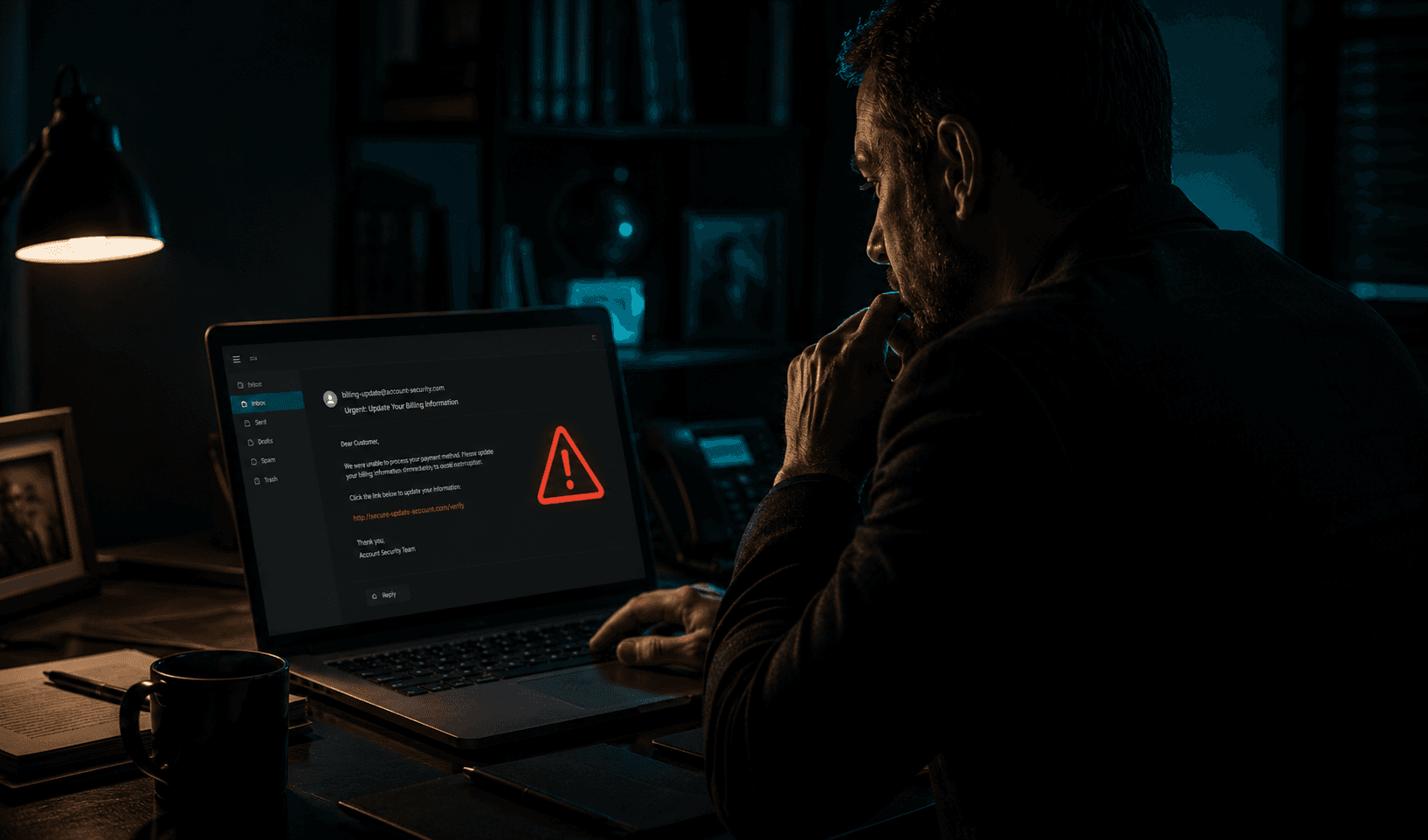
BUSINESS EMAIL COMPROMISE
& WIRE FRAUD PROTECTION.
BEC is the #1 cybercrime by financial loss — and it bypasses your existing email security. Simply IT protects law firms, accounting firms, real estate companies, and medical practices from wire fraud and executive impersonation attacks.
THE ATTACK YOUR EMAIL
FILTER WON'T CATCH.
Unlike phishing, BEC emails don't carry malware or suspicious links — they're plain text messages that look completely legitimate. Attackers spend days or weeks studying your organization before striking: monitoring email patterns, learning vendor names, and timing the attack to maximize urgency and minimize scrutiny.
The result is an email that passes every technical filter and looks exactly like something your CEO or your attorney would send. The only way to catch it is with AI-powered impersonation detection, domain authentication enforcement, and employees trained to verify wire requests before acting.
YOUR CURRENT SECURITY
HAS A BLIND SPOT.
No Malware to Detect
Standard email filters scan for malware signatures, bad attachments, and known phishing URLs. BEC emails contain none of these — they're plain text from what looks like a trusted sender.
Microsoft 365 Is Not Enough
Microsoft's built-in Defender misses up to 25% of advanced phishing and impersonation attacks. BEC actors specifically test their emails against Microsoft's filters before sending.
Social Engineering Beats Technology
BEC works because the email looks legitimate and creates urgency. Without employee training and verification procedures, even the best technical defenses can be bypassed by one rushed employee.
SIX WAYS CRIMINALS
TARGET YOUR BUSINESS.
CEO / Executive Fraud
Criminals impersonate your CEO or CFO via email, urgently requesting a wire transfer or gift card purchase. Often timed to Friday afternoons when executives are traveling.
Vendor Impersonation
Attackers compromise or spoof a vendor's email account and send updated banking instructions. Your accounts payable team wires payment to a fraudulent account.
Attorney / Legal Fraud
Criminals pose as your attorney or a title company attorney during a real estate closing or legal settlement, redirecting wire transfers at the last moment.
Payroll Diversion
Employees receive fake HR emails asking them to update direct deposit information. The next payroll cycle deposits their salary into the attacker's account.
Invoice Manipulation
Attackers intercept legitimate invoices or create fake ones from known vendors, changing the payment details. Common in construction and professional services.
Account Takeover
Attackers gain access to a legitimate email account through phishing or credential stuffing, then monitor conversations for weeks before striking at the right moment.
YOUR INDUSTRY IS
ON THEIR LIST.
Settlement funds, real estate closing wire instructions, and trust account transfers are prime targets. One diverted wire can mean hundreds of thousands in client losses.
Tax season wire fraud, vendor payment manipulation, and payroll diversion attacks surge during busy season. Your client trust makes you a high-value target.
Closing fund wire fraud is the #1 BEC attack vector. Title companies lose an average of $446,000 per successful attack. Buyer funds are non-recoverable after transfer.
Insurance reimbursement fraud, vendor impersonation for supply orders, and HIPAA violations from compromised email accounts create compounding liability.
A LAYERED DEFENSE
THAT ACTUALLY WORKS.
DMARC / DKIM / SPF Enforcement
We configure email authentication records that prevent criminals from spoofing your domain to attack your clients and partners. Set to p=reject — the strictest enforcement level.
Advanced Email Security Gateway
AI-powered impersonation detection, look-alike domain alerts, display name spoofing protection, and business email compromise-specific threat intelligence — layered on top of Microsoft 365.
Multi-Factor Authentication
Account takeover is the prerequisite for the most damaging BEC attacks. MFA on every email account eliminates the attacker's ability to send from a compromised legitimate address.
Security Awareness Training
Monthly simulated BEC attacks and training modules teach your team to recognize social engineering, verify wire requests by phone, and report suspicious emails immediately.
Wire Transfer Verification Procedures
We help you implement written policies requiring phone verification of all wire instructions, dual approval thresholds, and callback procedures using pre-verified numbers.
Incident Response
If a BEC attempt succeeds, every minute counts. We coordinate with your bank and the FBI IC3 to attempt wire recall and document the incident for insurance claims.
WHAT BUSINESSES
ASK US.
What is business email compromise (BEC)?
Business email compromise (BEC) is a sophisticated cyberattack where criminals impersonate executives, vendors, or attorneys via email to trick employees into wiring money or sharing sensitive data. Unlike phishing, BEC attacks often don't contain malware — they rely on social engineering and look completely legitimate. The FBI IC3 reported $2.9 billion in BEC losses in 2023 alone.
How does BEC bypass normal email security?
Standard email filters look for malware, bad links, and known spam signatures. BEC attacks contain none of these — they're plain text emails that appear to come from a trusted source. Attackers either compromise a real email account (account takeover) or register a look-alike domain (e.g., simplyit-biz.com instead of simplyit.biz). The email looks completely legitimate to both the filter and the employee.
What industries are most targeted by BEC attacks?
Law firms (wire transfers for settlements and real estate closings), accounting and CPA firms (tax refunds and vendor payments), real estate and title companies (closing funds), and medical/dental practices (insurance billing fraud) are the top targets. These industries regularly process large wire transfers and have high-value transactions that make fraud harder to detect quickly.
What is DMARC and does it stop BEC?
DMARC (Domain-based Message Authentication, Reporting, and Conformance) is an email authentication protocol that, combined with DKIM and SPF, verifies that emails claiming to be from your domain actually came from your servers. Setting DMARC to p=reject prevents criminals from spoofing your domain to attack your clients or vendors. It also protects your inbox from receiving spoofed emails from domains with DMARC enforcement. Simply IT configures DMARC, DKIM, and SPF as part of every security engagement.
What should I do if my company receives a suspicious wire transfer request?
Never wire money based on email instructions alone — always verify by phone using a number you already have on file (not one in the email). Establish a written wire transfer verification policy that requires a secondary approval for any transfer over a set threshold. If you suspect a BEC attempt, report it to the FBI IC3 at ic3.gov and call your bank immediately — wire transfers can sometimes be recalled within 24-72 hours.
How does Simply IT protect against business email compromise?
Simply IT deploys a layered BEC defense: DMARC/DKIM/SPF enforcement to block domain spoofing, advanced email security gateway with impersonation detection and AI-content analysis, multi-factor authentication on all email accounts to prevent account takeover, security awareness training so employees recognize social engineering tactics, and documented wire transfer verification procedures. We serve law firms, accounting firms, medical practices, and real estate companies in Ocala and North Central Florida.
Talk to a Simply IT specialist about BEC protection for your business — no obligation.
By submitting, you agree that Simply IT may contact you about your inquiry. See our Privacy Policy